PIN
TO WIN
Fast-Paced Geography Trivia That Gets Your Brain Working
Quick trivia sessions that challenge your geography, history, and world knowledge. Drop pins on a 3D globe, level up with XP, and climb ranked leaderboards — close guesses count!

EVERYTHING YOU NEED TO WIN
A complete geography gaming experience designed to challenge your brain and keep you coming back for more.
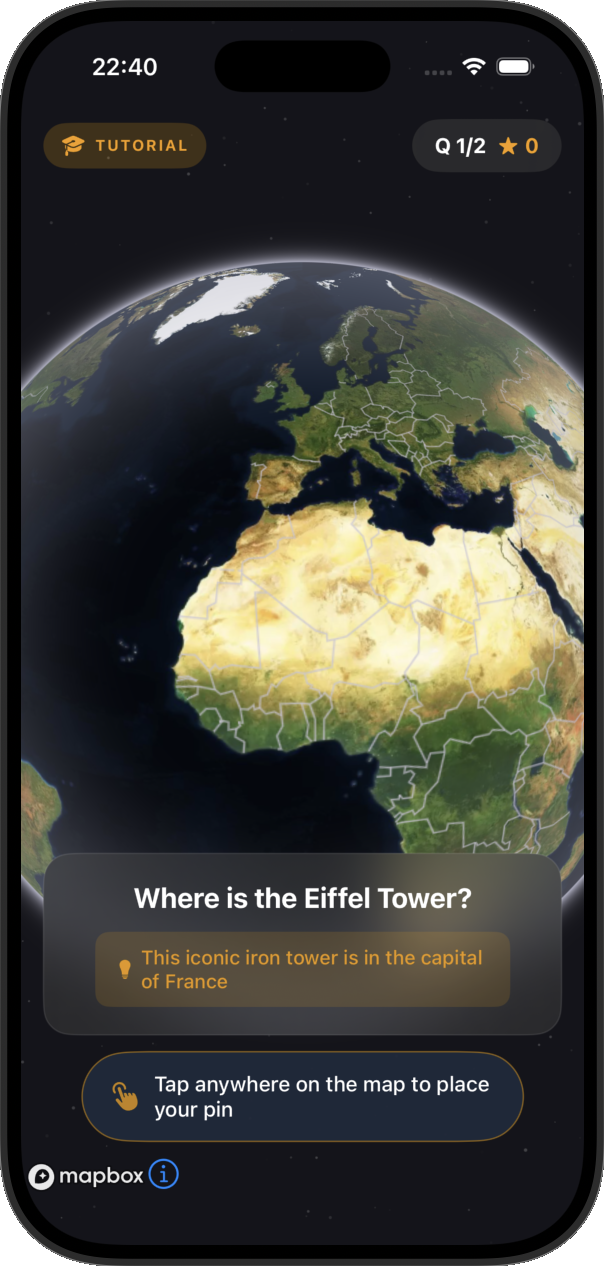
Interactive 3D Globe
Pin locations worldwide
- Spin, zoom & explore the world
- Drop pins with intuitive controls
- Learn geography through play
THREE STEPS TO GLORY
Geography buff or total beginner? Doesn't matter. Quick rounds that fit into any spare moment — a fun mental workout that keeps your brain sharp.
SPIN THE GLOBE
A location clue appears — maybe a famous landmark, a dish you've seen on TV, or a historical tidbit. Your job? Figure out where in the world it is.
PLACE YOUR PIN
Drag, zoom, and explore the 3D globe. When you've got a hunch, tap to drop your pin. No pressure — even your best guess counts.
DISTANCE = SCORE
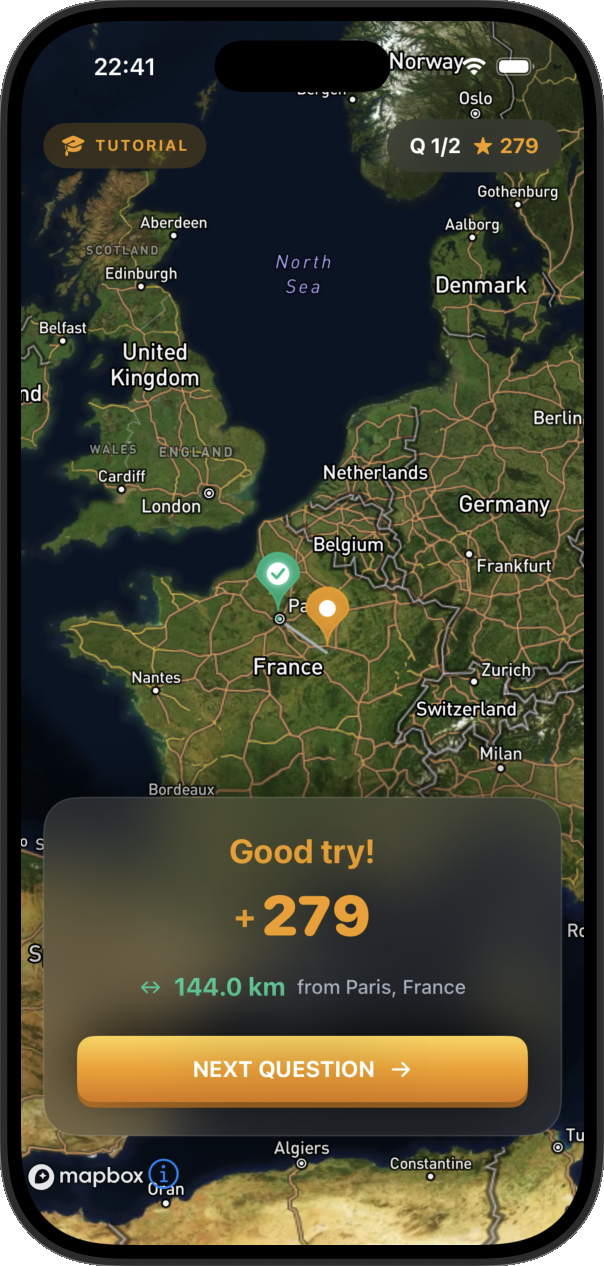
We measure how far you landed from the answer. Closer is better — 0km is perfect, but getting within a few hundred km still feels pretty great.
Lower distance = Better score — just like golf!
CLOSE COUNTS.
SERIOUSLY.
Most trivia apps punish you for being wrong. Not us. Pinquisite rewards how close you get — because knowing “somewhere in Northern Italy” shows real geography knowledge, even if you missed Milan by 50km.Think of it like golf: lower distance = better score!
Distance = Score
0km is a bullseye, but 200km still earns solid points. No more all-or-nothing frustration — your brain gets rewarded for being close.
Quick Mental Workout
Each 2-5 minute session challenges your mind. Studies show trivia quizzes improve memory retention better than passive learning. Your brain will thank you.
Thousands of Questions
3,000+ questions in Closed Beta, 6,000+ at full launch. Geography, history, landmarks, culture — text and picture questions from easy to expert.
CHOOSE YOUR CHALLENGE
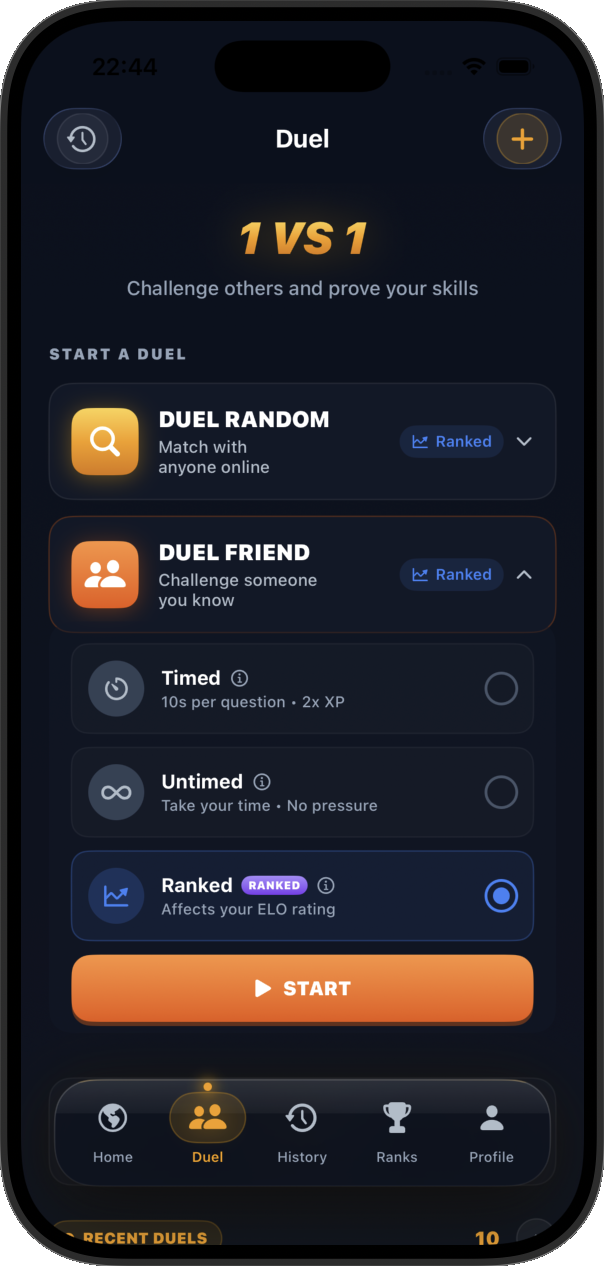
Quick solo brain training, rapid-fire 1v1 duels, worldwide daily quizzes, or private game nights — pick a mode and put your knowledge to the test.
SOLO
Quick Brain Training
10 questions mixing easy to expert. Play untimed to explore, or crank up the pressure with 15-second limits for bonus ranking points. Perfect for a quick mental break.
DUEL
Fast-Paced 1v1 Battles
5 rapid-fire questions, 15 seconds each. Same question, same moment, real opponent. Lower distance wins. Your skill earns ELO rank — Bronze to Master.
DAILY CHALLENGE
Same Quiz, Global Leaderboard
Everyone worldwide gets the same 10 questions. One shot per day. Build your streak, climb the global rankings, and see how you compare.
PARTY MODE
Group Trivia Night
Host a private room for 2-10 players. Share the code, compete on identical questions, watch live scores. Perfect for game nights with friends!
RISE THROUGH THE RANKS
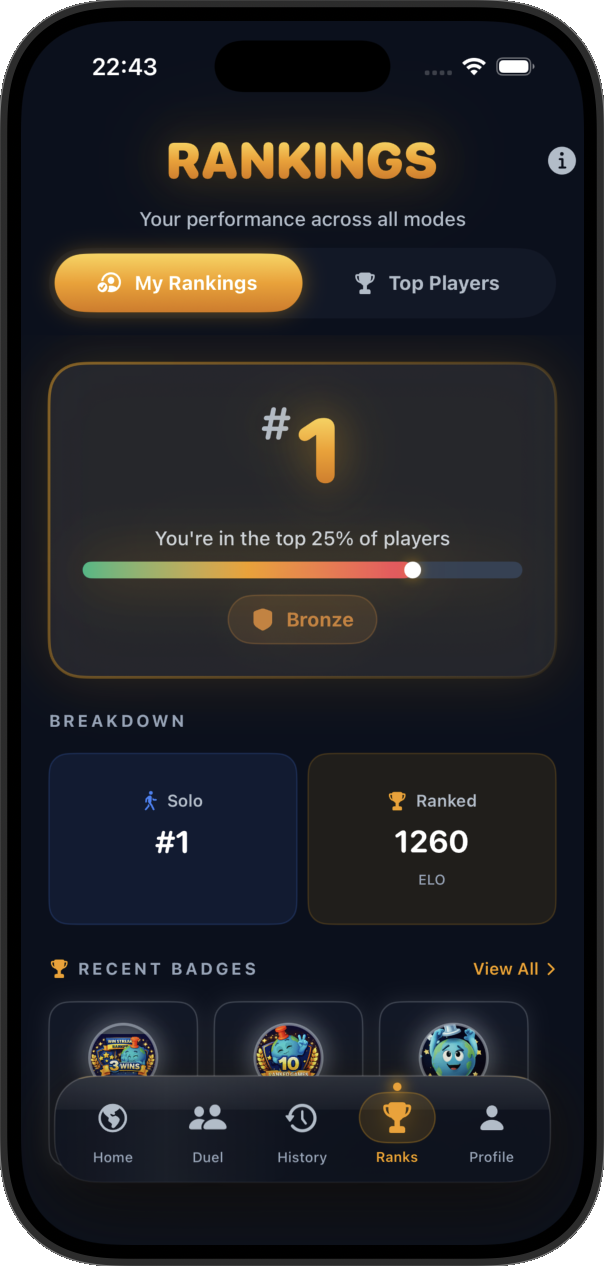
Everyone starts at 1200 ELO (Gold tier). Beat stronger players, gain more points. Lose to weaker ones, lose more. Fair, skill-based ranking — just like chess.
Remember: lower distance = better score = higher rank!
ELO Ratings
The same system chess grandmasters use. Beat better players, climb faster. Time limits and anti-farming rules keep it fair.
Multiple Leaderboards
Solo, Duel, Daily Challenge — each has its own rankings. Filter by country or friends to find your rivals.
RPG-Style Progression
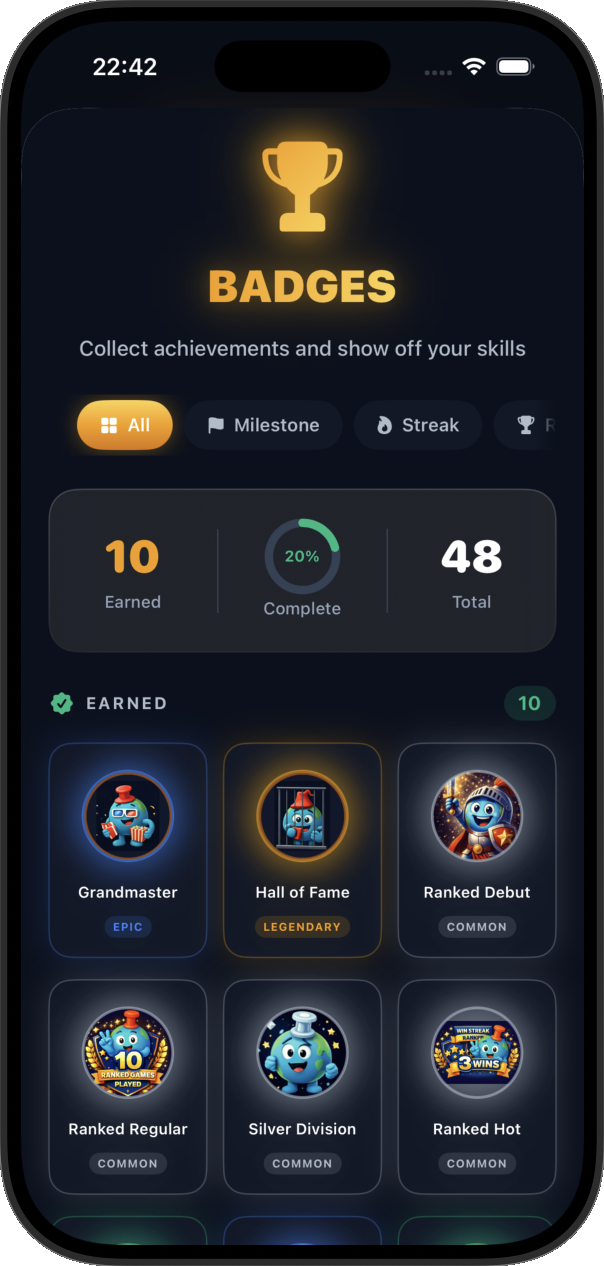
Earn XP, level up to 99, collect 50+ badges. Streaks give bonus XP. It's trivia with the satisfying crunch of an RPG.
BE THE FIRST TO PLAY
Join our waitlist for Closed Beta launching February 2nd. Get 1 month FREE full access and win premium subscriptions for your honest feedback!
IS THIS ACTUALLY GOOD FOR ME?
Spoiler: yes. Here's what the research says about online trivia games, quiz apps, and your brain.
Yep! Scientists call it the "testing effect" — when you quiz yourself on something, your brain remembers it way better than if you just read about it. A landmark study from Purdue University found that retrieval practice (a.k.a. quizzing) beats re-studying every time for long-term memory. Penn State research confirmed that students using online quizzes felt more engaged and better prepared. So every time you drop a pin on our globe, you're giving your brain a proper workout.
Source: Roediger & Karpicke (2006), Psychological Science; Penn State TLI Study
Online trivia isn't just fun — it's brain food. Research shows that trivia games work your frontal cortex (the part responsible for memory and reasoning), strengthen neural pathways through repeated recall, and even trigger dopamine release when you nail a tough question. A 2024 meta-analysis found that gamified learning improves academic performance by a significant margin. Plus, competitive trivia challenges add motivation that solo studying just can't match.
Source: Zeng et al. (2024), British Journal of Educational Technology
Actually, yes. Research from the University of Toronto found that games involving navigation and spatial reasoning can boost mental rotation abilities and spatial attention. When you're spinning our 3D globe and trying to pinpoint locations, you're training the same brain regions that help with real-world navigation. Geography quiz apps like Pinquisite combine trivia challenge elements with spatial learning — it's like a two-for-one brain workout. Bonus: these skills transfer to reading maps and even parallel parking.
Source: Spence & Feng (2010), Review of General Psychology
That little rush you feel? That's dopamine — your brain's reward chemical. Neuroscience research shows that when you anticipate and then receive a reward (like nailing a tricky trivia challenge question), your brain releases dopamine, which makes you want to keep playing. Experts say online trivia gives you a dopamine spike similar to gambling but without the downsides. It's basically your brain saying "nice job, do that again."
Source: Bromberg-Martin et al. (2010), Neuron
Both are great, but multiplayer trivia adds extra benefits. A 2023 survey found that 71% of people feel less stressed when gaming with others, and 58% feel less isolated. Research published in Nature (2025) found that online trivia games "cultivate a sense of unity and inclusion among players." Our Duel and Party modes tap into this — the friendly competition and social connection from online quiz challenges can genuinely boost your mood.
Source: Entertainment Software Association (2023); Nature Humanities & Social Sciences (2025)
There's solid evidence that staying mentally active matters. A Frontiers in Psychology study found that educational games combining cognitive challenge with learning are "optimally suited for promoting brain health." Another study showed that adults who regularly participate in intellectually engaging activities like online trivia show improved cognitive function over time. We're not saying our quiz app will cure anything, but keeping your brain engaged with trivia challenges definitely doesn't hurt.
Source: Manera et al. (2015), Frontiers in Psychology; Landau et al. (2012)
Research suggests mobile quiz apps can be even more effective for learning! A 2017 study found that students using gamified mobile quiz apps showed higher retention rates and better academic performance compared to non-users. The convenience of having a trivia app in your pocket means you're more likely to play regularly — and consistency is key for cognitive benefits. Short, frequent online quiz sessions beat occasional marathon study sessions every time.
Source: Alabbasi (2017), International Journal of Educational Technology in Higher Education
Great question. Unlike passive scrolling, online trivia requires active recall — you're constantly retrieving information and making decisions. This "effortful retrieval" is exactly what makes quiz apps so effective for memory. Research confirms that inserting brief quizzes into learning "reduces mind wandering, increases engagement, and promotes retention." Plus, with a geography trivia app like Pinquisite, you're learning actual world knowledge instead of just consuming content.
Source: Szpunar et al., Memory & Cognition; Bjork & Bjork (2011)
The research is clear: regular, short brain-training sessions beat marathon sessions. That's why our trivia challenge rounds are 5-10 questions — long enough to be meaningful, short enough to fit into a coffee break. Studies show the benefits of online quiz apps are strongest with consistent daily practice rather than occasional binges. Play a round or two of our trivia app daily and you'll notice the difference.
Source: Jaeggi et al. (2008), PNAS
Geography trivia apps offer unique benefits that general online quiz games don't. When you play Pinquisite, you're not just recalling facts — you're building spatial mental maps, improving your sense of global awareness, and training visual-spatial reasoning. Research published in the Review of International Geographical Education found that "geogames" effectively teach map skills, spatial thinking, and geographic inquiry while boosting motivation. It's trivia challenge meets brain training meets world exploration, all in one quiz app.
Source: Cezmi et al. (2021), Review of International Geographical Education (ERIC)
THE SURPRISING SCIENCE OF GEOGRAPHY GAMES
What happens in your brain when you play? (Spoiler: a lot of cool stuff)
You know that feeling when you nail a tough question? That little rush of excitement? Turns out, that's not just satisfaction — it's your brain literally rewiring itself. Let's talk about what's actually happening upstairs when you play geography trivia, and why scientists are getting increasingly excited about games like ours.
Your Brain on Curiosity (It's Like a Reward Party)
Here's something wild: when you're curious about something, your brain treats finding the answer the same way it treats food, money, or other rewards. A groundbreaking 2014 study published in Neuron found that curiosity activates your brain's dopamine system — the same circuitry involved in motivation and reward[2].
But here's where it gets interesting for trivia lovers: the researchers discovered that when you're in a curious state, you remember things better — even stuff you weren't trying to learn. So when you're playing Pinquisite and wondering "wait, where IS Mongolia exactly?", your brain is primed to soak up information like a sponge[4].
The science: Curiosity-induced dopamine doesn't just feel good — it actually enhances memory formation in the hippocampus. That "aha!" moment is literally building stronger neural connections.
The London Taxi Driver Effect (Yes, Maps Change Your Brain)
One of the most famous neuroscience studies ever conducted looked at London taxi drivers — the ones who spend 3-4 years memorizing "The Knowledge," a mental map of 25,000 streets. What researcher Eleanor Maguire found in 2000 was remarkable: these drivers had physically larger hippocampi (the brain region responsible for spatial memory) than average people[1].
Even more interesting? The size correlated with experience — the longer someone had been driving a taxi, the bigger their posterior hippocampus. This was groundbreaking evidence that spatial learning literally changes your brain structure[1].
Now, we're not saying playing Pinquisite will give you taxi-driver-level hippocampal gains (those folks put in thousands of hours). But the principle is clear: engaging with maps and spatial information is genuine exercise for your brain. A 2024 study found that people who regularly navigate complex environments show better spatial brain volume and reduced risk of cognitive decline[6].
Why Trivia + Challenge = The Ultimate Brain Workout
Here's where we get to the good stuff. Researchers at Frontiers in Psychology found that educational games combining cognitive challenge with learning content are "optimally suited for promoting brain health"[5]. The key word there is combining.
Think about it: when you play a geography game, you're not just passively consuming information. You're:
- Retrieving memories (recall practice strengthens neural pathways)
- Making spatial judgments (engaging your mental map systems)
- Experiencing curiosity (triggering dopamine release)
- Getting immediate feedback (reinforcing correct associations)
- Competing or collaborating (adding social motivation)
A 2024 meta-analysis found that brain training games have "statistically significant effects" on cognitive function, with benefits for working memory and processing speed across different age groups[8].
The Long Game: Keeping Your Mind Sharp Over Time
We want to be straight with you: no game can prevent dementia or cure Alzheimer's. Anyone claiming otherwise is overselling. But the research on mentally stimulating activities is genuinely encouraging.
A 2024 Texas A&M study found that older adults with mild cognitive impairment who engaged in high levels of mentally stimulating activities — including word games and puzzles — showed better memory, attention, and processing speed than those who didn't[7]. Another long-term study found that frequent game players showed a 2.5-year delay in the onset of cognitive decline symptoms.
The evidence suggests that keeping your brain engaged matters. It's like physical exercise — we can't guarantee it will prevent every health problem, but staying active is clearly better than not. And honestly, isn't it nice when "good for you" is also fun?
The Bonus: Social Connection Amplifies Everything
Here's something researchers keep finding: the cognitive benefits of games increase when there's a social component. A 2023 survey found that 71% of people feel less stressed when gaming with others, and 58% report feeling less isolated. Research published in Nature in 2025 found that online trivia games "cultivate a sense of unity and inclusion among players."
This is why we built Duel mode and Party mode into Pinquisite. Sure, you can play solo (and that's great too!), but there's something special about challenging a friend to see who knows more about South American capitals. That friendly competition isn't just motivating — it's actually enhancing the cognitive benefits.
The Bottom Line
Look, we built Pinquisite because we love geography and wanted to create something fun. The fact that science backs up real cognitive benefits? That's a happy bonus.
When you play, you're not just killing time. You're triggering your brain's reward system, strengthening spatial memory circuits, practicing recall (one of the most effective learning techniques known), and maybe even building a little extra grey matter in the process.
Not bad for a few minutes of "where's that mountain?"
This article summarizes peer-reviewed research for educational purposes. While we've done our best to accurately represent the science, always consult healthcare professionals for medical advice.
Ready to Prove Yourself?
THE GLOBE IS
WAITING
Join the waitlist for Closed Beta launching February 2nd. Get 1 month FREE full access. Share honest feedback and win premium subscriptions as a reward!
Think you know where everything is? Accept the challenge and prove it.